
Strangely and some might say bizarrely, it was a scene from Evelyn Waugh’s novel Brideshead Revisited that came to mind as I was preparing for this feast.
If you are familiar with the novel or film then you may recall towards the end, Charles Ryder and Julia Flyte, now lovers, return to Brideshead and Julia’s brother, Bridey, arrives and announces his impending engagement to Mrs Beryle Muspratt.
Julia quickly suggests that Bridey should have brought her down with him so that they could meet. After a moment’s silence Bridey declared that he couldn’t possibly do that. Then in a classic Evelyn Waugh gifted sentence he said: “You must understand that Beryle is a woman of strict Catholic principles fortified with the prejudices of the middle classes. I couldn’t bring her here…It is a matter of indifference whether you choose to live in sin with Rex or Charles or both…but in no case would Beryle consent to be your guest.”
There followed, naturally enough, very emotional scenes and eventually Charles and Julia sit near the great fountain at Brideshead and Charles remarked:
“It’s like the setting of a comedy…Scene: a Baroque fountain in a nobleman’s grounds. Act one, sunset; act two, dusk; act three, moonlight. The characters keep assembling at the fountain for no very clear reason.’ ‘Comedy?’ ‘Drama. Tragedy. Farce. What you will. This is the reconciliation scene.”
Julia responds harshly, “Why must you see everything second-hand? Why must this be a play? “And there is the line that lodged itself in my head. “Why must you see everything second-hand…like a play?”
The constant danger with our faith, our liturgy, perhaps even our life itself is seeing things second-hand – as spectators rather than full participants. The direct remark of Bridey concerning the conflicting relationship of Charles and Julia with the teaching of the Catholic faith was a wake-up call, a moment of cold reality for Julia. Her situation was no drama, it was real. The way she was choosing to live outside the sacramental life of the Church. This would have eternal consequences. The time had come to stop living things second hand but fully in the drama of God. There was an encounter with eternal life and daily choice.
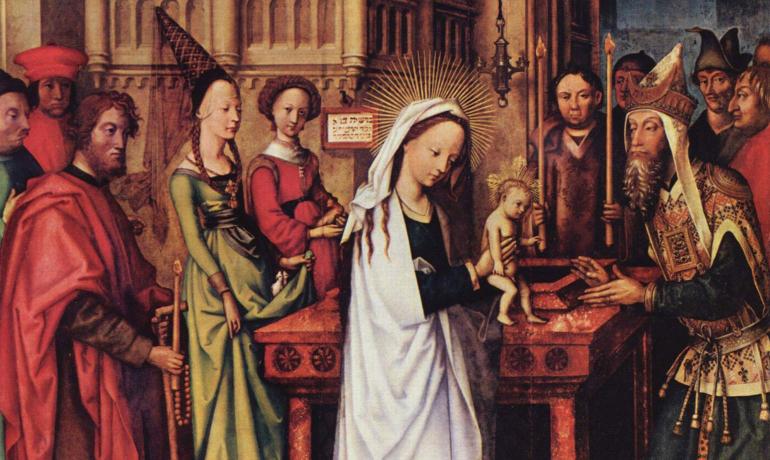
The Gospel today sums all this up in one simple sentence: “When the time came the parents of Jesus took him up to Jerusalem to present him to the Lord.” It’s all about offering, consecration and mission. This is the real drama. As Bishop Robert Barron likes to call it the ‘Theo-drama’. I like very much the title given to today’s feast in the Eastern Church, it is known by the beautiful title the feast of the encounter. This is revealed with great clarity in the Gospel that has just been proclaimed to us (cf. Lk 2:22-40).
In the temple Jesus comes to meet us and we go to meet him. We see this in the encounter with Simeon and Anna, who represents the anticipation of the promises of God. God surprises constantly by His creativity in coming to meet us personally rather than sending an envoy. In Jesus is the past, made of memory and of promise, as well as the future, full of hope.
No wonder the Church decided in her wisdom, therefore, to designate this ‘feast of encounter’ as a day upon which we pray for consecrated life. In this presentation of Jesus in the temple we can see the beginning and foundation of all consecrated life: Offering, Consecration and mission. Here is the point: Consecrated men and women are called first and foremost to be men and women of encounter. Our vocation originates not from a career choice, but from a grace that has touched us, a person that has brought about a life-changing encounter.
In a letter written by Sr Simona Brambilla, Prefect of the Dicastery for Institutes of Consecrated life and Societies of Apostolic Life, entitled: Prophecy of Presence. Sr Simona reminds us that in many parts of our world, indeed wherever consecrated people are there is revealed “how strong the prophetic dimension of consecrated life is as “presence that remains”: alongside wounded peoples and individuals, in places where the Gospel is often lived in conditions of fragility and trial.” This is why she concludes her letter with the words:
“We entrust each and every one of you to the Lord, that he may make you steadfast in hope and gentle in heart, capable of remaining, of consoling, of beginning anew; and thus, to be in the Church and in in the world, a prophecy of presence and a seed of peace.”
Those who truly encounter Jesus cannot remain the same – why would they? Those who experience this encounter, this living presence, become witnesses - lights to the nations - and make the encounter possible for others. A prophecy of presence and a seed of peace. The Second reading from Hebrews reminded us that to encounter us, Jesus did not hesitate to share our human condition: “Since, therefore, the children share in flesh and blood, he himself likewise partook of the same nature” (2:14). Jesus did not save us “from the outside”, he did not remain outside of our drama, but wanted to share our life.
Consecrated men and women are called to be a tangible and prophetic sign of this closeness of God, of this sharing in the condition of frailty, of sin and of the wounds of today’s mankind. Prayer brings us to this realisation of the closeness of God in the depth of our experience. Prayer is rooted in what is real. So, this feast invites each of us not to experience life, God, our vocation second hand, but fully immersed in the mystery and drama of God. Let us pray that we be true, not second hand but truly an offering a consecration and a mission.
Abbot Robert Igo, OSB
Feast of the Presentation
2 February 2026


