
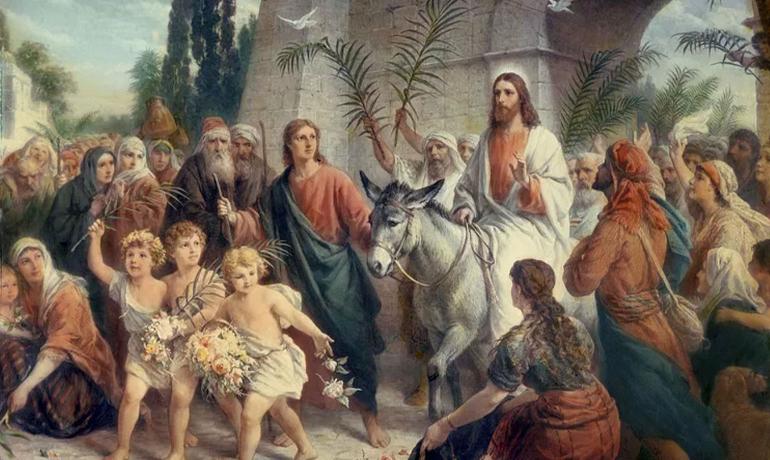
While palm branches have traditionally become associated with this day and for good reason, the truth is, it is only John’s Gospel that identifies the branches that the people cut from the trees as palm branches. Though often a symbol of peace, waving palm branches for these first century Jews and laying them before Jesus was a much more provocative act. It represented their desire for national sovereignty and independence from Rome. It was a defiant call for liberation and regime change.
The real focus however of Jesus’ entry into the holy city was not so much what the people were waving or indeed what they placed on the ground before Him, the real focus was what had provoked them into action and excitement. Why were they jubilant and shouting “Hosanna to the Son of David, Blessed is he who comes in the Lord’s name?” The answer is simple, it was the donkey and its foal, these were the actual triggers for what raised the crowd’s expectation that the Messiah had come to establish His Kingdom. So, believe me when I say that I am not being flippant, but I wonder if more accurately today ought to be called: ‘The Sunday of the Donkey and its colt’?
Every action and word of Jesus was intentional. He clearly taught that He had come to fulfil the law and the prophets concerning the Messiah. He wanted the world to know and understand that He was the promised Redeemer. On how many occasions Jesus visited Jerusalem because, like every Jew, He was obligated to make pilgrimage to this holy place three times a year for Passover, Pentecost and Tabernacles but on this occasion, he chose a very deliberate way to enter the city, he chose to ride on a donkey with its attendant foal.
For those who were accompanying Him from Bethany and Galilee and for the other pilgrims gathered in Jerusalem when He entered the city through the Eastern gate, also known as the Gate of Mercy. It could only have one possible meaning and they would have immediately remembered the great prophecy of in Zechariah 9:9:
“Behold, your king is coming to you;righteous and having salvation is he, humble and mounted on a donkey, on a colt, the foal of a donkey.”
Interestingly, the rabbinic tradition declared that if Israel was found worthy of redemption, then the Messiah would come on the clouds of heaven, as prophesied in Daniel 7. However, if Israel was not worthy, then Mashiach would come poor riding on a donkey with its foal! He would come, therefore, not with power but with humility. He would come first as a lamb for slaughter before he was revealed as the lion of the House of David.
Riding on the donkey, therefore, was the clearest sign yet that Jesus had come as the Messiah to redeem Israel but note this, not only was His mode of transport noteworthy, but the very day He chose to enter Jerusalem, four days before the Passover, the very day upon which the sacrificial lambs were chosen for sacrifice. This was no accidental gesture; it was highly suggestive. But why a donkey and a foal?
First, donkeys in the Old Testament are far from irrelevant and sometimes played a key role in the history of the redemption of God’s people. I think Genesis 22 and Abraham uses of a donkey to carry everything necessary for the sacrifice of Isaac. Also, Moses in Exodus 4:20, he puts his wife and children on a donkey when he comes to free Israel from slavery in Egypt. The there is Solomon in 1 Kings 1:33-38 he was ordered by King David not to ride to Gihon on a splendid horse, to be anointed King like a warrior, but on a donkey as a clear gesture of peace. But there is more, there always is with God.
Many Rabbis felt that the donkey and its colt represented two different realities: heaven and earth, the material reality and the spiritual. Later Church Fathers went further and saw them as representing the old covenant and the new covenant. The Rabbis pointed out that the root Hebrew word for donkey: chomer means ‘material’, ‘matter’, that is something physical. Donkeys were of the earth - material. Therefore, for the Messiah to come riding on a donkey with its foal was a divine declaration, a manifestation of God’s great desire to sanctify once again His physical creation. God longed to restore the balance, to bring harmony between heaven and the material world. To turn the clock back to before the fall.
Today’s celebration gives each one of us an opportunity to reflect on the connection between the physical world around us and the spiritual world into which we have been adopted. How do these two realities come together so that we have a clear and transparent relationship with both? Our vocation as disciples of Yeshua is to sanctify our life at every level. God wants to affect the material world in ways that restore and elevate it. After all, when he created, he saw everything as good.
The simple action of Jesus riding on this donkey reveals the desire of God to restore the interconnection between heaven and earth, it’s the perfect fusion of the spiritual with the material. So, let us not forget that Jesus was on top of the donkey emphasising where our priority is to be. We are not physical beings who happen to have a spiritual experience. We are spiritual beings who seek to find God in and through the physical reality we experience.
Today, therefore, poses a question for each of us: Are you riding the donkey with Jesus or is the donkey riding you? Are you riding with the King or are you being ridden by the world around you and all its concerns? This week changes everything and the donkey asks which direction are you going?
Abbot Robert Igo, OSB
29 March 2026


